Doha, 20 Feb 2026 (Qatar Tribune)
By Ashraf Siddiqui
The major developments unfolding in Iran since late December are reshaping the country’s image domestically, regionally, and internationally, said Prof. Mahjoob Zweiri, a scholar of contemporary Middle Eastern politics with a specialisation in Iran and the Gulf.
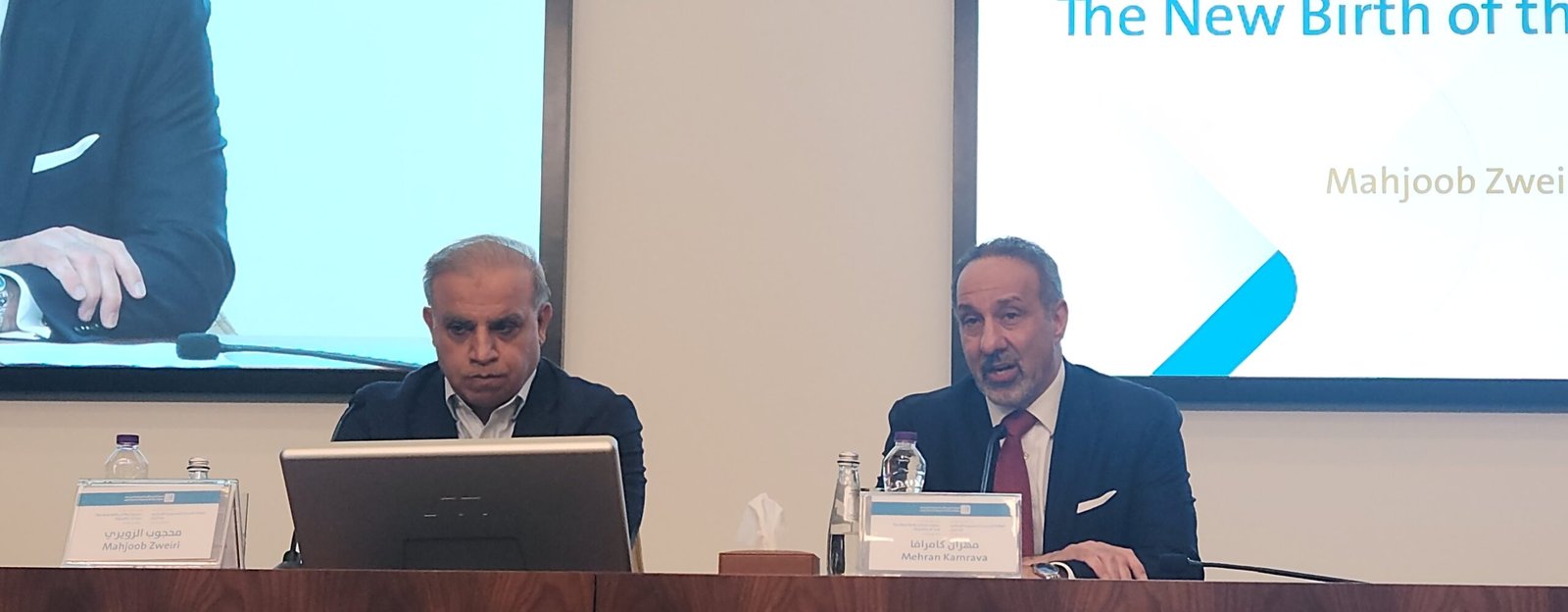
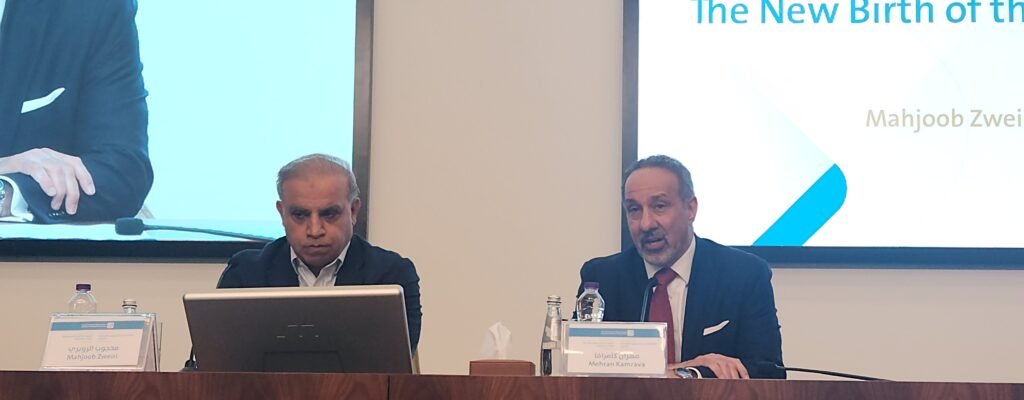
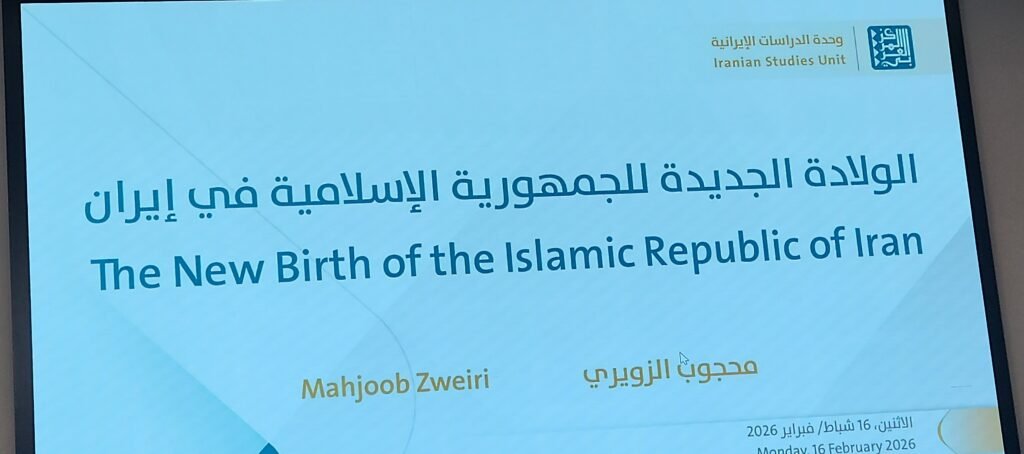
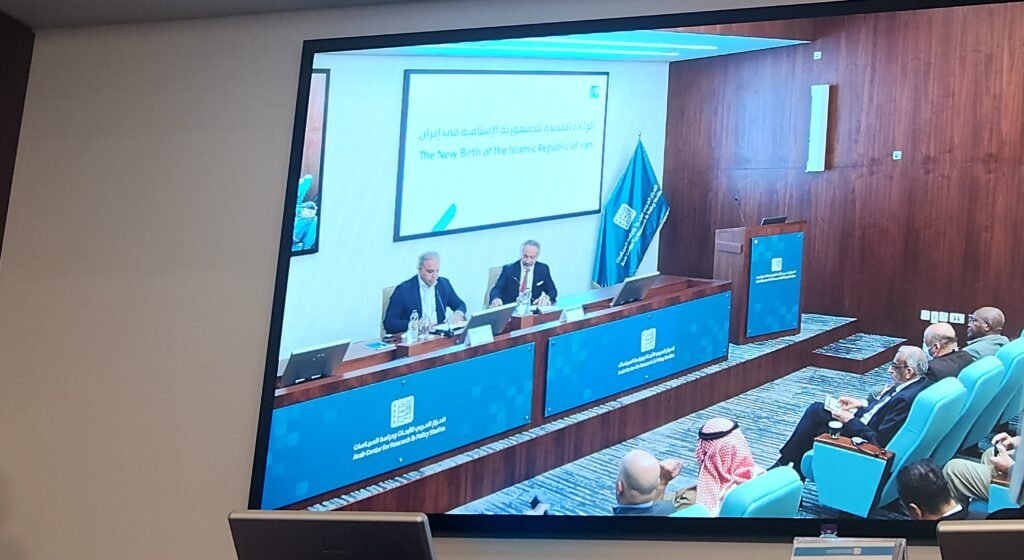
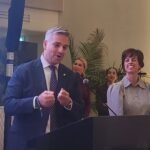
Speaking at a recent lecture at the Arab Center for Research and Policy Studies titled ‘The New Birth of the Islamic Republic of Iran’, Prof. Zweiri offered a sweeping yet grounded reflection on what he called the Islamic Republic of Iran’s “new birth.”
Mahran Marwa, professor of Government at Georgetown University, Qatar Campus welcomed the audience and explained the urgency of the gathering.
Addressing an audience of diplomats, scholars and students, Prof. Zweiri framed Iran’s current moment not as a sudden rupture, but as part of a long, uneven evolution shaped by ideology, survival instincts, and shifting regional realities.
He described the 1979 revolution as Iran’s first “birth,” when a revolutionary movement solidified into a governing system.
He said that in its early decades, the Islamic Republic focused on consolidating power at home and projecting confidence abroad, expanding state institutions, integrating rural populations through development campaigns, and entrenching religious norms across public life.
Despite leadership shifts—from reformist to conservative presidents—the system showed a capacity to adapt without surrendering its core identity, he added.
“The nuclear issue became a defining stress test. Beginning in the early 2000s, mounting international scrutiny and sanctions gradually strained Iran’s economy. Negotiations with world powers eventually produced the 2015 nuclear agreement. For a brief period, it appeared that Iran might ease its isolation and stabilize its regional posture,” Prof. Zweiri said.
“That possibility unraveled in 2018 when U.S. President Donald Trump withdrew from the Joint Comprehensive Plan of Action and reinstated sanctions.”
Zweiri sees this as the trigger for Iran’s “second birth.”
In response, Supreme Leader Ali Khamenei announced what he termed the “Second Step” of the revolution, marking the regime’s entry into a new phase at its 40-year milestone.
This second phase, Zweiri argued, rests on two pillars. The first is “purification”—a sharper distinction between loyal insiders and those viewed as insufficiently committed to the system. The second is the “resistance economy,” designed to withstand sanctions and reduce reliance on the West. Yet these strategies unfolded amid intensifying pressure, economic hardship, and growing public frustration.
Regionally, the landscape has also shifted dramatically. The killing of General Qasem Soleimani in 2020 was a profound shock. Subsequent tensions with Israel escalated beyond the shadow war long waged in Syria.
Zweiri noted that Israeli strikes on Iranian-linked targets had occurred for years, but recent confrontations have been more direct and exposed vulnerabilities in Iran’s deterrence posture. Meanwhile, instability in Syria weakened a crucial strategic corridor that once anchored Iran’s regional network.
Despite cultivating closer ties with Russia and China, Iran has not secured the level of backing that would decisively offset Western pressure. Europe, once more diplomatically engaged, has adopted a firmer tone.
At home, economic strain and periodic unrest underscore what Zweiri described as institutional fatigue.
Yet he stopped short of predicting collapse. Instead, he suggested that Iran now appears more focused on stabilisation than expansion.
Managing relations with the United States to avoid large-scale war, recalibrating ties with neighbours, and preserving ideological cohesion are central to this delicate balancing act, he said.
Nearly five decades after its founding, the Islamic Republic stands at a crossroads. Its “second birth” remains unfinished—its future dependent on whether it can adapt to mounting internal and external pressures without losing the foundations that have sustained it since 1979.
Link Qatar Tribune
Iran’s current stance shaped by ideology, survival instincts: Experts - Read Qatar Tribune on the go for unrivalled news coverage

 American Chamber of Commerce Qatar
 Bangladeshi Community
 Filipino Community
 Indian Community
 Nepali Community
 Pakistani Community
 Sri Lankan Community