Rawalpindi, 07 Jan. 2026
In a comprehensive press briefing yesterday, Tuesday, Pakistan’s military spokesperson presented a stark review of the nation’s counter-terrorism efforts, declaring 2025 a decisive year while levelling serious allegations against neighboring Afghanistan and criticizing domestic political impediments.
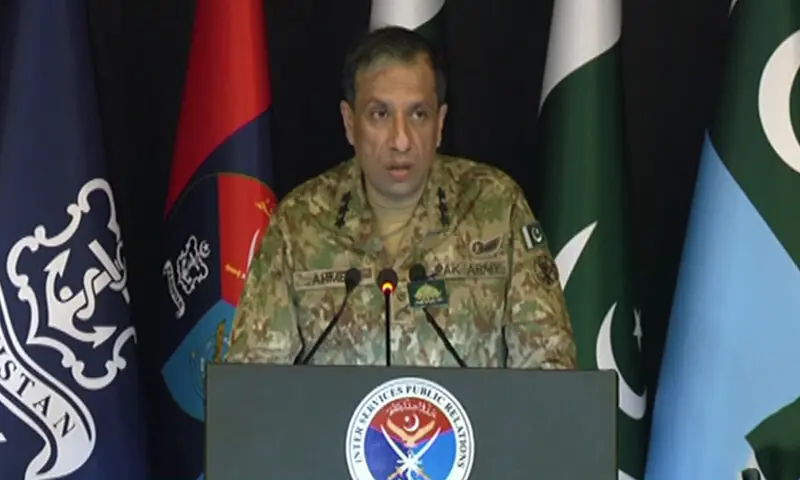
Lt. Gen. Ahmed Sharif Chaudhry, Director General of Inter-Services Public Relations (ISPR), Media and Public Relations Wing of Armed Forces of Pakistan, outlined what he termed four reasons making 2025 a “landmark and consequential year” in the long-running conflict. These were: achieving national clarity that terrorists are “Khawarij” with no relation to Islam; international acknowledgment of Afghanistan as a terrorist base; the reinvigoration of the National Action Plan (NAP); and an unprecedented intensity in military operations.
The Data of Conflict
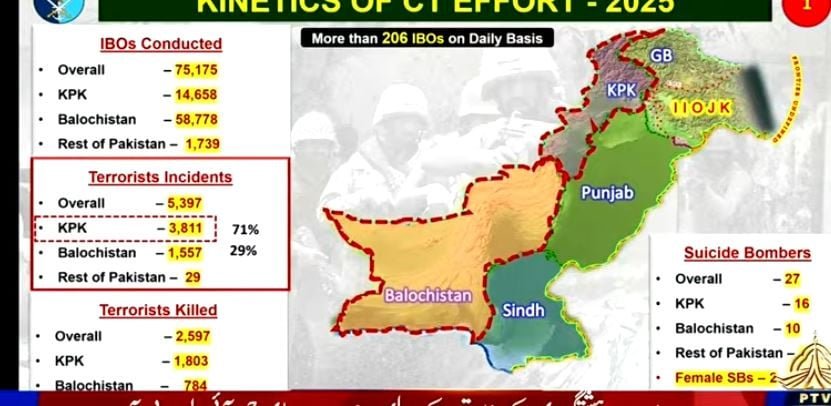
The briefing was grounded in extensive operational statistics. He reported that Pakistani security forces, including the army, police, and intelligence agencies, conducted a staggering 75,175 intelligence-based operations (IBOs) in 2025, an average of 206 per day. The majority occurred in provinces of Balochistan (58,778) and Khyber Pakhtunkhwa (14,658).
These operations responded to 5,397 terror incidents, which resulted in 2,597 terrorists killed. The human cost for the state was high: 1,235 law enforcement personnel and civilians lost their lives. Notably, the DG ISPR highlighted a shifting tactical ratio, from three security force martyrs for every terrorist killed in 2021, to two terrorists killed for every martyr in 2025, framing it as evidence of increasing operational effectiveness.
The Afghan Nexus and Cross-Border Strikes
A central pillar of the military’s narrative was the alleged role of Afghanistan. GLt Gen Chaudhry asserted that the Afghan Taliban, since taking power in 2021, had reneged on its Doha Agreement commitments, allowing the country to become a “hub for terrorists and non-state actors.” He specifically accused the Afghan Taliban of organising, training, and directing the banned Tehreek-i-Taliban Pakistan (TTP).
This external threat, he claimed, is financially and tactically sponsored by India, a connection he termed “Fitna-al-Hindustan.” He presented this India-Afghan Taliban nexus as the primary engine of terrorism in Pakistan, providing a “base of operations” and patronage.
The spokesperson directly linked a spike in terrorism after May 2025 to India’s reaction to a military defeat in a brief conflict with Pakistan. This escalation, he said, culminated in Pakistan’s cross-border strikes in October 2025. He vigorously defended these strikes, clarifying they targeted only Pakistani TTP militants on Afghan soil, not the Afghan Taliban state or Afghan nationals. He contrasted this with what he labelled India’s deliberate targeting of Pakistani civilians in May, calling any comparison between the two events a deceptive “spin.”
The subsequent closure of the Pak-Afghan border, he stated, had proven beneficial, reducing terrorist infiltration and increasing monthly terrorist fatalities.
Internal Hurdles: The KP Challenge
While identifying an external axis, Gen. Ahmed Sharif Chaudhry was equally pointed about internal challenges, particularly in province of Khyber Pakhtunkhwa (KP). He identified a “politically conducive environment” and a “political-terror nexus” flourishing in the province as the primary reason for it bearing 71% of the country’s terror incidents.
He criticised the KP government, led by Chief Minister Sohail Afridi, for a policy of “appeasement,” including seeking negotiations with Kabul and hindering the repatriation of Afghan refugees. He noted that while refugee camps in provinces of Punjab and Balochistan had been cleared, only five of 43 in KP had been processed, with a low rate of deportations.
The DG ISPR also highlighted systemic issues in KP, such as a high number of pending terrorism cases and low conviction rates in courts, which he said undermined the judicial pillar of the NAP. He defended the military’s ongoing operations in KP as a constitutional duty under federal mandate, asserting that “no personality or politics is above Pakistan’s sovereignty.”
Balochistan: A Model for the National Action Plan?
In stark contrast to his critique of KP, Director General ISPR offered province of Balochistan as a potential model for implementing the revised NAP. He praised the provincial government for establishing district-level coordination committees that integrate local political representatives, civil administration, and security officials. He detailed that these committees had planned 949 development projects with significant federal and provincial funding, completed 127, and conducted over 54,000 public engagement activities.
He also highlighted Balochistan’s decision to abolish the distinction between “A” and “B” areas, extending police authority province-wide, and allocating funds for police training. This “whole-of-government” approach, he suggested, was effectively combating the “terror-crime nexus” at the grassroots level.
Rebuttals and Clarifications
The spokesperson used the platform to counter several public narratives. He denied that counter-terrorism operations were motivated by economic interests (“dollars and minerals”). He clarified that while terrorists frequently use armed quadcopters, security forces use drones only for surveillance, taking extreme care to avoid collateral damage in kinetic strikes.
Responding to questions about past engagement with the TTP, he distinguished between institutional policy and the actions of specific individuals in previous governments, suggesting some were “used for politics.” He maintained the military’s current clarity, that there can be no talks with terrorists, which originated from the army’s leadership in 2023.
Regional Dynamics and Future Resolve
On regional policy, ISPR Spokesperson Ahmed Sharif Chaudhary stated Pakistan engages with the Afghan Taliban as the de facto authority out of necessity, citing numerous diplomatic engagements and protests over three years. He expressed consensus with China on the regional terrorism threat. Regarding Afghanistan’s future, he said Pakistan would “curate its policy based on circumstances,” focusing on its own security.
He concluded with a message of unwavering resolve, asserting that the nation and its military were united with “singularity of purpose.” “No power in the world can stop us from winning this fight,” he stated, framing the conflict as an existential struggle for Pakistan’s survival, to be won not by appeasement but by determined force.
The briefing presented a military confident in its operational gains but framing the ongoing war as a multi-front battle against a foreign-backed insurgency, complicated by what it sees as damaging political compromises within Pakistan’s own borders.

 American Chamber of Commerce Qatar
 Bangladeshi Community
 Filipino Community
 Indian Community
 Nepali Community
 Pakistani Community
 Sri Lankan Community