Caracas, 03 Jan. 2026
The US President Donald Trump has announced that the US would now “run Venezuela” to oversee a “safe, proper and judicious transition.” He explicitly tied this to the nation’s vast oil reserves, the largest in the world, suggesting U.S. companies would fix “broken infrastructure” and “start making money for the country.”
The message was a potent mix of moral crusade, geopolitical muscle, and economic interest, capped with a blunt warning: the U.S. was “ready” for a second, larger attack if needed. Vice President JD Vance echoed this, stating Maduro had ignored “multiple off ramps” and now learned that “President Trump means what he says.”
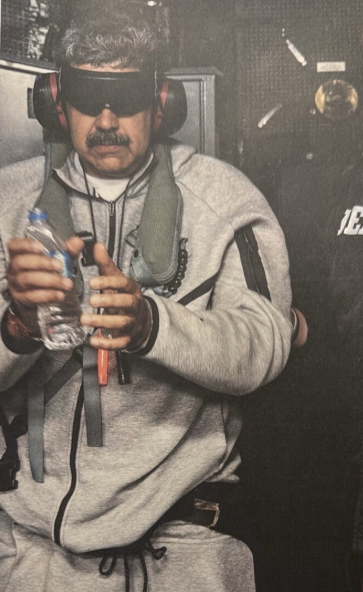
The predawn hours over Caracas were shattered not by the usual tropical dawn, but by the roar of aircraft and the concussive thump of explosions. By sunrise on January 3rd, 2025, the geopolitical landscape of the Western Hemisphere was irrevocably altered. In an Operation Absolute Resolve that unfolded with cinematic swiftness, United States forces penetrated the heart of Venezuela, capturing President Nicolás Maduro and his wife, Cilia Flores, and sparking an international crisis of staggering proportions. The event has left a nation in paralyzing uncertainty, a region on the knife’s edge of conflict, and the world grappling with the blunt-force assertion of American power.
From his Mar-a-Lago estate, President Donald Trump framed the mission in stark, triumphant terms. To him, it was a necessary surgical strike against a narco-terrorist regime. “If you would’ve seen the speed, the violence, it was an amazing thing,” he told Fox News, describing watching the capture “literally like I was watching a television show.” He painted a picture of a flawless military feat, delayed only by weather, targeting a leader holed up in a “fortress” of “solid steel.”
The legal rationale was presented by U.S. Attorney General Pam Bondi, who detailed a sweeping indictment from the Southern District of New York. Maduro was charged with Narco-Terrorism Conspiracy, Cocaine Importation Conspiracy, and weapons offenses. “They will soon face the full wrath of American justice on American soil in American courts,” she declared, labeling the couple “alleged international narco traffickers.”
As per NBC News reporting, New York Mayor Zohran Mamdani condemned the unilateral attack against Venezuela as "an act of war and a violation of federal and international law." He argued that this overt attempt at regime change directly impacts New York, home to tens of thousands of Venezuelans.
Mamdani, who was sworn into office this past Thursday, stated his primary focus is on the safety of all New Yorkers. His administration, he said, will monitor the situation and provide relevant guidance.
He also noted he was briefed about the military capture of President Nicolás Maduro and his wife, Cilia Flores, and "their planned imprisonment in federal custody here in New York City."
But beyond the courtroom, Trump articulated a broader, more contentious vision for Venezuela’s future.
“The Insolent Foot of the Foreigner”: Venezuela’s Defiance and Disarray
In Venezuela, the response was one of furious defiance and profound confusion. The government, now operating under the voice of Vice President Delcy Rodríguez, declared a “state of External Disturbance” and denounced a “grave military aggression.” In a fiery statement evoking the spirit of liberator Simón Bolívar and past battles against empire, the Bolivarian Republic accused the U.S. of a flagrant violation of the UN Charter, aiming to seize Venezuela’s oil and minerals. “They will not succeed,” it thundered, calling citizens to the streets and reserving the right to “legitimate self-defense.”
On the ground in Caracas, however, the mood was less of revolutionary fervor and more of numb apprehension. Eyewitnesses described eerie silence punctuated by hushed conversations. Queues formed at pharmacies and supermarkets, with shutters drawn on some 24-hour stores. The familiar, acrid scent of tear gas wafted through some neighborhoods—a haunting reminder of past unrest. There were fleeting moments of euphoria from anti-Maduro residents, but these were quickly swallowed by the overwhelming uncertainty. As one woman whispered to a reporter while searching for medicine for her nerves, “Do you know what happened?”
The power vacuum is immediate and dangerous. With Maduro’s authority physically removed, the question of who governs hangs in the air. Three figures loom large: Vice President Delcy Rodríguez, the civilian face of continuity; Defense Minister Vladimir Padrino López, who controls the military’s loyalty; and powerful party insider Diosdado Cabello, who holds immense influence within the Chavista machinery. Their next moves—whether they present a unified front or fracture into competing factions—will determine if the state holds together. Meanwhile, the opposition leader María Corina Machado, claiming a victory in the disputed 2024 elections and currently abroad, watches closely, her role in any U.S.-managed “transition” entirely undefined.
“A Dangerous Precedent”: A World United in Alarm
The international reaction has been swift and overwhelmingly critical, transcending traditional geopolitical blocs and highlighting the profound unease with the U.S.’s unilateral action.
The United Nations set the tone of grave concern. Secretary-General António Guterres called the events a “dangerous precedent,” deeply alarmed that “the rules of international law have not been respected.” He and UN human rights chief Volker Türk emphasized the paramount need to protect Venezuelan civilians and pursue inclusive dialogue.
Venezuela’s traditional allies, China and Russia, issued blistering condemnations. China denounced the “hegemonic acts” that “seriously violate international law,” while Russia condemned the “armed aggression,” urging a focus on dialogue to prevent escalation.
Perhaps most telling was the reaction from Latin America, a region historically sensitive to U.S. interventionism. Even leaders critical of Maduro expressed deep dismay. Chilean President Gabriel Boric condemned the U.S. military actions. Colombian President Gustavo Petro, a leftist who has sought dialogue with Maduro, took the concrete step of deploying troops to their shared 2,000-km border, preparing for a potential humanitarian crisis as Venezuelans might flee renewed violence. He urgently called for meetings of the UN and OAS. Cuba’s president denounced the “criminal attack,” and even Guyana, locked in a territorial dispute with Venezuela, mobilized its security forces and called for calm.
The European Union struck a more diplomatic but still pointed note. While reiterating that Maduro “lacks legitimacy” and supporting a peaceful transition, the bloc’s top diplomat called for “restraint” and full respect for international law—a clear signal of discomfort with Washington’s methods.
The United Kingdom’s new Prime Minister, Keir Starmer, found himself in a delicate position. While stating unequivocally that the UK was “not involved in any way,” he stopped short of condemnation, saying he needed to “establish the facts” and speak to allies. His emphasis on upholding international law, however, placed him subtly at odds with the U.S. operation’s apparent breach of it.
At the Crossroads: An Unscripted and Perilous Future
The world now watches a nation and a region plunged into the unknown. Several critical, unresolved questions will shape the coming days and weeks:
- The Fate of Maduro: Is he truly en route to a New York courtroom? His trial would be a historic, explosive event, but could also solidify his martyrdom for supporters and inflame tensions.
- The Battle for Caracas: The stability of Venezuela hinges on the cohesion of the Chavista state apparatus. Will Rodríguez, Padrino, and Cabello unite, or will a struggle for power erupt, potentially leading to civil conflict or a fracturing of the military?
- The Opposition’s Gambit: What is the plan for María Corina Machado and the disparate opposition? Will they be invited into a U.S.-administered transition, or sidelined? Their acceptance is crucial for any legitimate political process.
- The Regional Domino Effect: Will other Latin American nations, beyond statements, take concrete actions in solidarity with Venezuela? Could this spark a broader anti-U.S. mobilization in the region? Colombia’s border mobilization is a first, tangible step into a potential crisis.
- The “Transition” Paradox: President Trump’s pledge for the U.S. to “run” Venezuela is perhaps the most legally and politically fraught aspect. It evokes memories of 20th-century gunboat diplomacy and colonial administration. How will this “running” be structured? Who will the U.S. work with inside Venezuela? The utter lack of detail suggests an operation brilliantly executed for capture, but perilously unplanned for the arduous task of governance and political reconciliation.
The capture of Nicolás Maduro is not an ending, but a violent and chaotic beginning. It has replaced the stagnant, suffering status quo in Venezuela with a dynamic and explosive volatility. The streets of Caracas are quiet not with peace, but with the breath-held anxiety of a people who have endured years of crisis and now face an even more uncertain dawn. The world has witnessed a powerful state redraw the rules of engagement, and the repercussions—for the principle of national sovereignty, for the stability of Latin America, and for the lives of 30 million Venezuelans—are only just starting to unfold. The path ahead is unscripted, perilous, and holds the potential for either catastrophic collapse or, against all odds, a painfully forged new beginning.
Independent Editor Sam Kiley in his analysis mentions ‘doing otherwise would be to acknowledge that Donald Trump has swung America first from being a friend’ then to being an unreliable ally and now, in the dawn of 2026, Trump\s America
is a threat. He said he would attack Venezuela’s mainland, and he has.
A senior Venezuelan official, speaking anonymously about preliminary reports, stated the attack on Saturday claimed at least 40 lives, among them military personnel and civilians.
More to come on this developing story

 American Chamber of Commerce Qatar
 Bangladeshi Community
 Filipino Community
 Indian Community
 Nepali Community
 Pakistani Community
 Sri Lankan Community